Short answer: “Speed to lead” is the time between a new enquiry and your first real response. A study of 1.25 million sales leads at 42 US companies, published in Harvard Business Review in 2011, found firms that responded within an hour were nearly seven times as likely to qualify the lead as those that waited even an hour longer. An automated flow captures the lead, scores it, sends a personal reply in seconds, offers a real booking slot and logs everything in your CRM.
Why the first hour matters
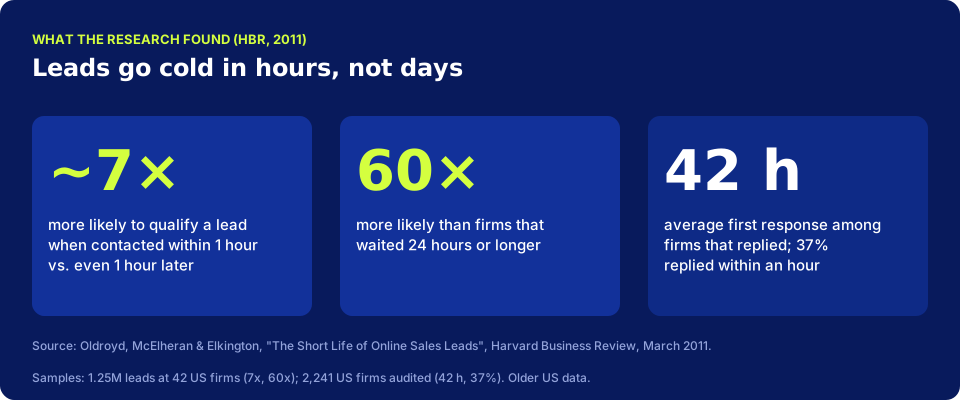
In 2011 a research team published two linked studies in Harvard Business Review. First, they analysed 1.25 million sales leads received by 42 US companies (29 consumer, 13 business-to-business). Firms that tried to contact a lead within an hour were nearly seven times as likely to qualify it as firms that waited even one hour longer, and more than 60 times as likely as firms that waited 24 hours or more. Second, they sent one test web lead to each of 2,241 US companies and timed the reply: only 37% responded within an hour, and among firms that replied within 30 days the average first response took 42 hours.
The reason is simple. When someone fills in a form, they are thinking about the problem right now. They often contact two or three providers at once. The first useful reply sets the frame for everything after it.
The five-step automated flow
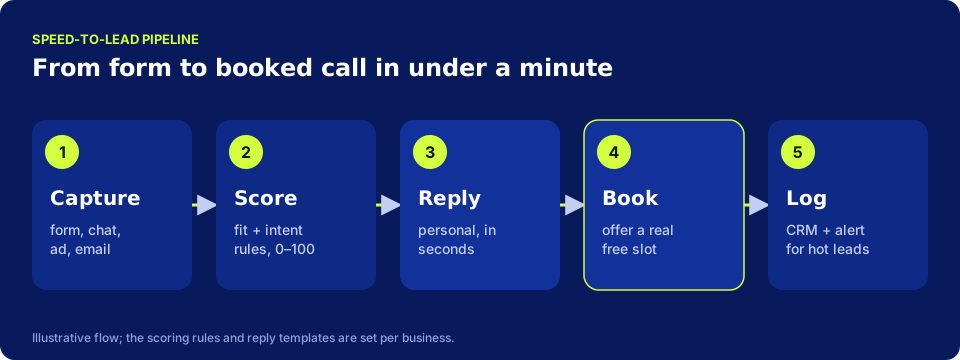
1. Capture
Every source (website form, chat widget, ad lead form, email inbox) feeds one queue. No lead sits in a mailbox nobody checks on Sunday.
2. Score
Clear rules give each lead a score: does it match your services and area (fit), and how urgent or specific is it (intent)? An AI model can read free-text messages and extract details like budget, timeline or service type, but the scoring rules stay yours and visible.
3. Reply
The lead gets a personal reply within seconds that answers what they actually asked, not a generic “thanks, we’ll be in touch”. Drafts follow your templates and tone; high-value or unusual leads can be held for a person to check before sending.
4. Book
The reply offers a real open slot from your calendar, so a hot lead can book a call in two taps. The system must avoid offering the same slot to two people at once.
5. Log and alert
Every lead, score, message and booking lands in your CRM. Hot leads trigger an instant alert to the right person by email, Slack or SMS, with a one-line summary.
Common mistakes
- Fast but empty replies. An instant reply that says nothing useful is barely better than a slow one.
- Black-box scoring. If sales cannot see why a lead scored 85, they will ignore the score.
- No human path. Some leads want a person. Make that one click away.
- Not measuring. Track time-to-first-reply and booking rate before and after, so you know it works.
See it working
Our Lead → Booking Autopilot demo runs this whole flow on sample leads: scoring with a visible breakdown, an AI-drafted reply, a proposed slot, a CRM table and a team alert. It is an in-house build you can test before talking to us.
Questions people ask
What is a good lead response time?
Aim for minutes, not hours. The Harvard Business Review study of 1.25 million leads at 42 US companies found contact within the first hour made qualification nearly seven times more likely than waiting even one more hour.
Does automation make replies feel robotic?
It does if the reply ignores what the person asked. Good flows answer the actual question, use your tone and offer a clear next step such as a booking link.
Which CRM does this work with?
Most flows connect to common CRMs such as HubSpot, Pipedrive or Zoho through their APIs, or to a simple shared sheet for small teams.
Can a person review messages before they are sent?
Yes. A common setup sends routine replies automatically and holds high-value or unusual leads for a quick human check.