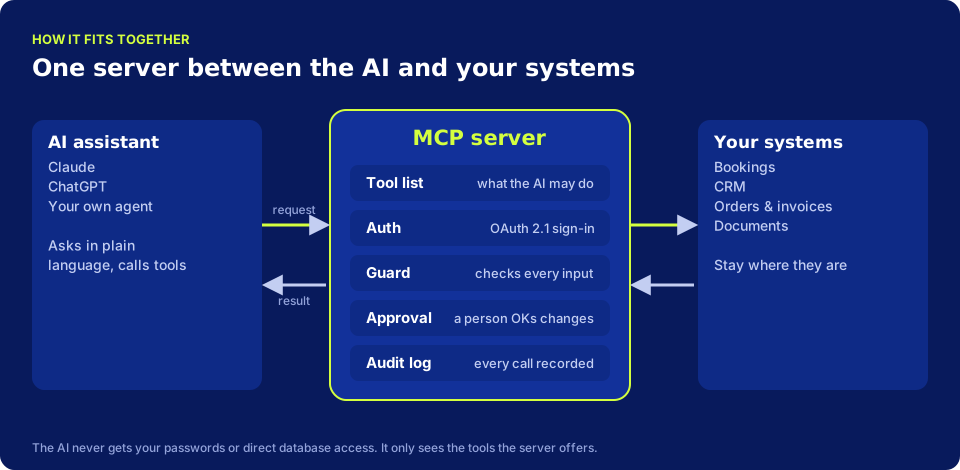
Short answer: An MCP (Model Context Protocol) server is a small piece of software that sits between an AI assistant and your business systems. It tells the AI which actions it may take, such as “check availability” or “look up an order”, checks every request, and can require a person to approve any change. Your passwords and databases stay with you.
What MCP is, in one paragraph
The Model Context Protocol is an open standard that Anthropic introduced in November 2024 so AI applications can connect to outside tools and data in one consistent way (modelcontextprotocol.io). Before MCP, every AI product needed its own custom plug-in for every system. With MCP, you build one server for your system and any assistant that speaks MCP can use it: Claude, ChatGPT (through custom connectors), coding tools and your own agents.
How it works, step by step
- The server publishes a list of tools. Each tool is one action with a name, a description and the inputs it needs, for example
check_availability(service, date). - The assistant picks a tool. When a user asks “Do you have a cleaning slot on Thursday?”, the AI decides the availability tool fits and calls it.
- The server checks the call. It confirms who is signed in, validates the inputs and rejects anything outside the rules.
- The server talks to your system through your existing API or database, and returns only the fields needed.
- The assistant answers in plain language, using real data instead of guessing.
Under the hood the messages use JSON-RPC, and remote servers sign users in with OAuth, so each person grants access to their own account. You do not hand an AI model a shared password.
The part that matters most: control
An AI that can only read is low risk. An AI that can change things, such as booking an appointment, issuing a refund or editing a customer record, needs guard rails. The pattern we use is simple: reads run straight away; writes wait for a person.
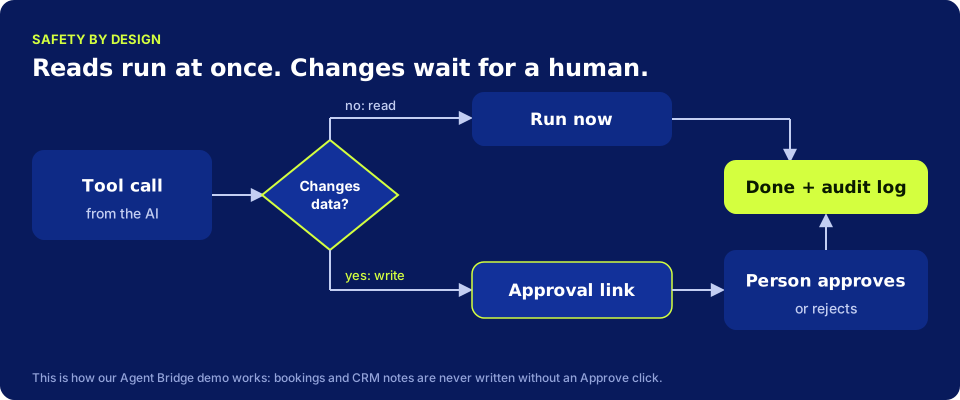
Two other protections are worth insisting on. First, prompt-injection guards: text coming back from a tool (an email, a web page, a customer note) is treated as data, never as instructions to the AI. Second, an audit log that records every call, its inputs, its result and who approved it, so you can answer “what did the AI do yesterday?” in seconds.
What businesses use MCP servers for
- Front desk: check availability, book or move appointments (with approval), answer “where is my order?”
- Sales: look up a lead in the CRM, add a call note, draft a follow-up for review.
- Operations: pull an invoice, match it to a purchase order, flag differences.
- Internal knowledge: search policies and manuals with links back to the source page.
If you want to see one working, our Agent Bridge demo is a live MCP server for three fictional businesses. You can watch every request cross the server, approve or reject writes, and even add the same server to your own Claude or ChatGPT in about a minute.
What does an MCP server cost to build?
The server itself is usually the smallest part of the job. The cost depends on three things:
- How many tools you expose and how messy the underlying system is. A clean, documented API is fast; an old system with no API is not.
- Whether writes are allowed, which adds approval screens, roll-back rules and more testing.
- Sign-in and hosting: per-user OAuth, logging and monitoring.
A read-only server with three to five tools on a system that already has an API is typically a small fixed project. Our starting prices are on the pricing page; we quote every project in writing after a short scoping call.
Six questions to answer before you start
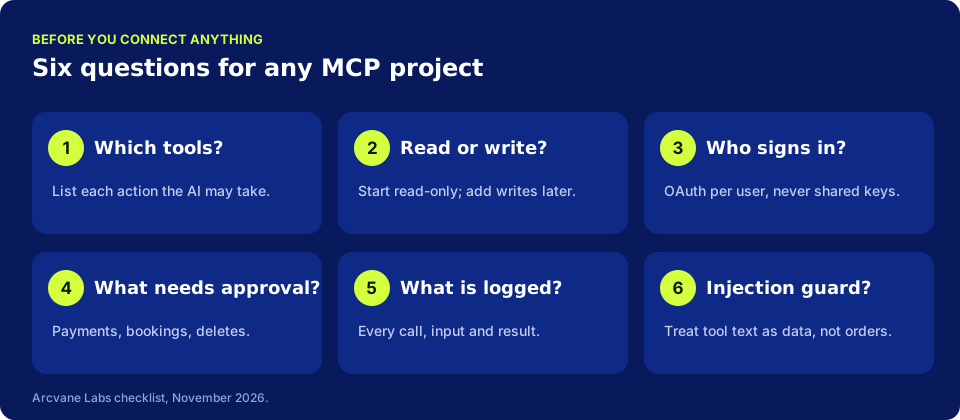
Start read-only, prove the value with one team, then add write tools one by one with approval. That order keeps risk low and makes the business case obvious.
Questions people ask
Is MCP only for Claude?
No. MCP is an open standard. Claude supports it, ChatGPT supports remote MCP servers through custom connectors in developer mode, and many coding tools and agent frameworks can act as MCP clients.
Does the AI get access to my whole database?
No. The AI only sees the tools the server offers and only the fields each tool returns. Your database credentials stay on the server.
Can an MCP server make changes without asking?
Only if you build it that way. We recommend that every write (bookings, refunds, record edits) waits for a person to approve it, and that every call is logged.
How is MCP different from an API?
An API is how software talks to your system. An MCP server wraps that API in a form AI assistants understand: named tools with descriptions, sign-in for each user and rules about what needs approval.