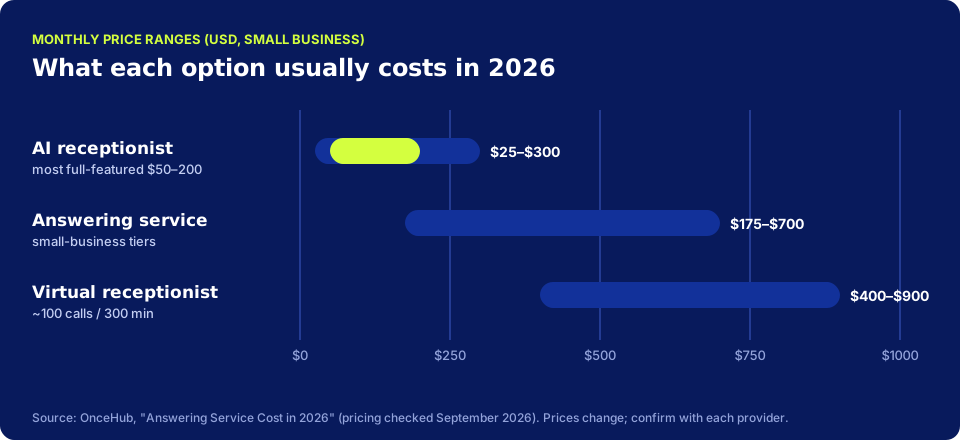
Short answer: In 2026 most AI receptionists cost about $50–$200 a month, human answering services for a small business about $175–$700, and virtual receptionist plans around $400–$900 at roughly 100 calls a month (OnceHub, September 2026). AI wins on repeat questions, bookings and after-hours cover; people win on judgment and sensitive calls. Many businesses do best with a hybrid: AI first, warm handoff to a person.
What each option costs
A price roundup of US providers published by OnceHub in September 2026 gives a useful snapshot of list prices (published plans, not a survey of what businesses actually pay):
- AI receptionists: roughly $25–$300 a month, with most full-featured options between $50 and $200. Usually billed per seat or as a flat monthly fee, not per minute.
- Human answering services: about $175–$700 a month for small-business tiers, with per-minute overages of roughly $1.75–$5.40.
- Virtual receptionists: entry plans from about $137, but around $400–$900 a month at a realistic volume of about 100 calls.
These are subscription prices for off-the-shelf products. A custom AI receptionist connected to your own booking system and CRM costs more to set up, but you own it and pay only for hosting and AI usage afterwards.
What an AI receptionist does well
- Answers instantly, every time, including nights, weekends and three calls at once.
- Handles the repeat questions (hours, prices, location, parking, insurance accepted) consistently, from your own approved answers.
- Books, moves and confirms appointments when connected to your calendar, and sends a text confirmation.
- Logs everything: a transcript and a summary in your CRM for every call or chat.
- Speaks more than one language without extra staff.
Where people are still better
- Judgment calls: an unhappy customer, an unusual request, a complaint that needs a decision.
- Sensitive or regulated topics: medical, legal or financial questions that need a qualified person.
- Relationship callers: long-standing clients who expect to hear a familiar voice.
A good AI receptionist knows its limits. It should recognise these calls and hand them to a person with a summary, rather than trying to answer.
How to decide
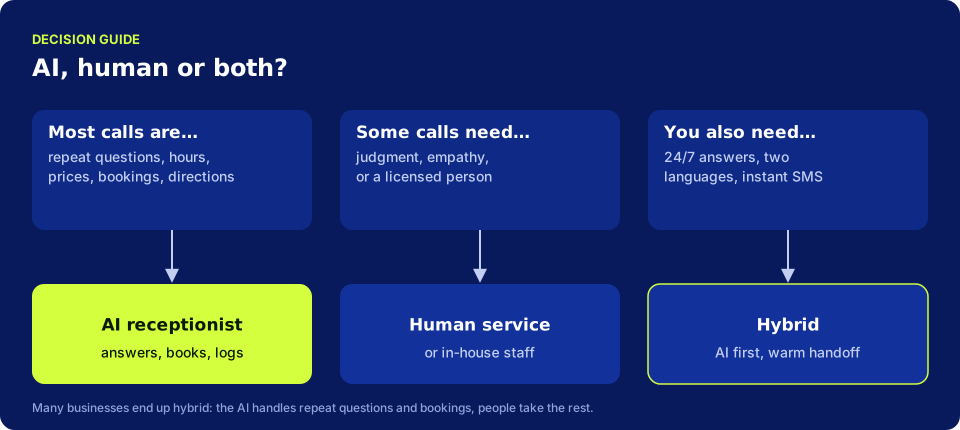
Before choosing, pull a week of calls and messages and sort them into three piles: could be answered from a FAQ, is a booking or change, and needs a person. If the first two piles are most of the volume, an AI front desk will pay for itself quickly. If the third pile dominates, put the money into people and use AI for after-hours only.
What to check before you buy
- Can it answer only from your approved information, and say “I don’t know” otherwise?
- Does it connect to your calendar and CRM, or only take messages?
- How does the handoff to a person work, and does the person get a summary?
- Where are recordings and transcripts stored, and for how long?
- Can you test it on real questions before you pay?
You can try the last point now: our AI Front Desk demo runs a chat and a browser voice receptionist for a sample business, with bookings, handoff and a call summary.
Questions people ask
How much does an AI receptionist cost per month?
Most full-featured AI receptionist products cost about $50–$200 a month in 2026, with the overall range roughly $25–$300 (OnceHub, September 2026). Custom builds connected to your own systems have a setup cost plus hosting and AI usage.
Will an AI receptionist replace my front-desk staff?
Usually not entirely. It removes repeat calls and after-hours gaps so staff can focus on in-person customers and calls that need judgment.
Can an AI receptionist book appointments?
Yes, if it is connected to your calendar or booking system. Good setups confirm the slot back to the caller and log the booking in your CRM.
Do callers mind talking to an AI?
Callers mostly mind slow answers and being stuck. Say clearly that it is an AI assistant, keep answers short and always offer a way to reach a person.